July 4th Special Renewals campaign · Results from the supplied performance brief, prepared July 10, 2026.
My role
Weiss Ratings · Senior Retention Manager
At Weiss Ratings, I lead subscription retention and renewal strategy, set the test plan, and manage a Retention Marketer. For this campaign, I changed how we presented the renewal offer.
The customer decision
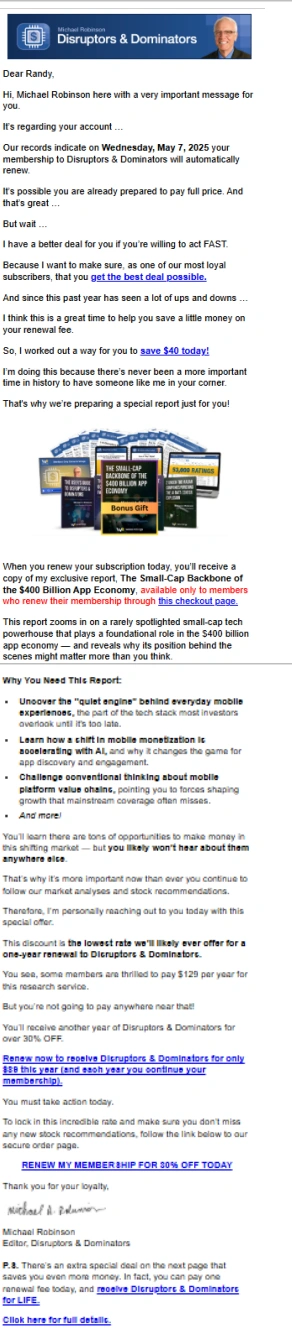
Existing subscribers were being asked to make a renewal decision through a long-form editorial letter. The control led with the editor’s relationship and authority, used text-link calls to action, and introduced pricing later.
The new version put the offer earlier in the email so subscribers could see the price, compare their options, and renew.
What changed
01 / CLARITY
Lead with the offer.
Bring the pricing choices toward the top of the message.
02 / CHOICE
Make options visible.
Show the renewal options side by side.
03 / ACTION
Make the buttons easy to find.
Replace subtle text-link emphasis with prominent gold buttons.
This tested the redesigned campaign as a whole, including its offer presentation and bonus incentive. It does not isolate the effect of button color or any other single element.
The creative
Compare the purchase-focused redesign with the existing editorial control. These are excerpts from the supplied campaign archive.

The measured result
| Metric | Control A | New VerB | Relative change |
|---|---|---|---|
| Sends | 21,704 | 21,742 | — |
| Unique buyers | 26 | 42 | +61.5% |
| Buyer conversion rate | 0.120% | 0.193% | +60.8% |
| Net revenue | $10,511 | $15,271 | +45.3% |
| Revenue per send | $0.484 | $0.702 | +45.0% |
| Average order value | $404.27 | $363.60 | −11.2% |
More response, with a tradeoff. The new version generated more buyers and more net revenue, while average order value declined. The revenue result is observed in this test; statistical significance was not established in the supplied brief.
A closer look at the revenue
A small number of large orders affected the revenue totals. The brief’s sensitivity check removes $6,600 from the control and $10,450 from the new version. Revenue then becomes approximately $3,911 versus $4,821: a lift of about 23.3%.
The new version still comes out ahead, but by a smaller margin. I’d follow this with a larger test and look at ways to improve average order value.
Source: supplied July 4th Split Test Performance Brief. Its pricing references differ between the screenshots and analysis, so this case study does not state a universal offer price.